
For years, digital growth followed a logic that felt predictable: increase output, expand channels, publish more content, generate more traffic and optimize conversion. The relationship between effort and results was not perfect, but it was stable enough to guide strategy, budgets and execution.
That logic is now breaking down.
Businesses are operating with more digital activity than ever before, yet growth is becoming less consistent, more expensive to sustain and harder to scale with predictability. What once looked like a performance problem is increasingly a structural limitation.
Most companies misread the signal. When results slow down, the natural response is to refine campaigns, improve SEO, produce better content, adopt new tools and optimize every measurable layer of performance. These actions can be useful, but they often fail to address the deeper issue.
The problem is not located in one isolated activity. It exists in how all activities connect.
As digital environments evolve into more complex digital ecosystems in business, growth stops being a direct result of effort alone and becomes a property of the system itself. At this stage, doing more does not automatically create better outcomes. In many cases, it creates fragmentation, operational friction and diminishing returns.
This is where traditional growth logic reaches its limit. What restricts performance is no longer only the quality of individual actions, but the structure that connects content, data, SEO, CRM, automation, customer experience and authority signals into a coherent system.
When systems are not designed to integrate data, processes and content into a unified structure, every improvement remains local. A campaign may generate traffic. A page may rank. A tool may collect data. A CRM may store leads. But if those actions do not reinforce one another, the results remain fragmented and fail to compound over time.
This is precisely where digital business infrastructure becomes critical.
Rather than being a purely technical layer, digital business infrastructure defines how the entire digital system operates: how data flows, how decisions are made, how content is structured, how customer relationships are managed and how authority is built over time.
In simple terms, digital business infrastructure is the system that connects data, technology, processes, content and customer interactions into a unified structure that enables scalable growth.
When this foundation is missing, businesses often experience the pattern explored in why businesses fail to build digital ecosystems: they accumulate tools, channels and activity without creating the architecture required for growth to compound.
When the foundation is present, the opposite happens. Content supports authority. SEO connects market demand to the right structure. Data improves decisions. CRM preserves relationship context. Automation creates continuity. Customer experience reinforces trust. The business stops depending on isolated execution and starts building a system that continuously strengthens itself.
This article explores how digital ecosystems, digital authority and growth engines connect through infrastructure to transform fragmented execution into scalable, system-driven growth.
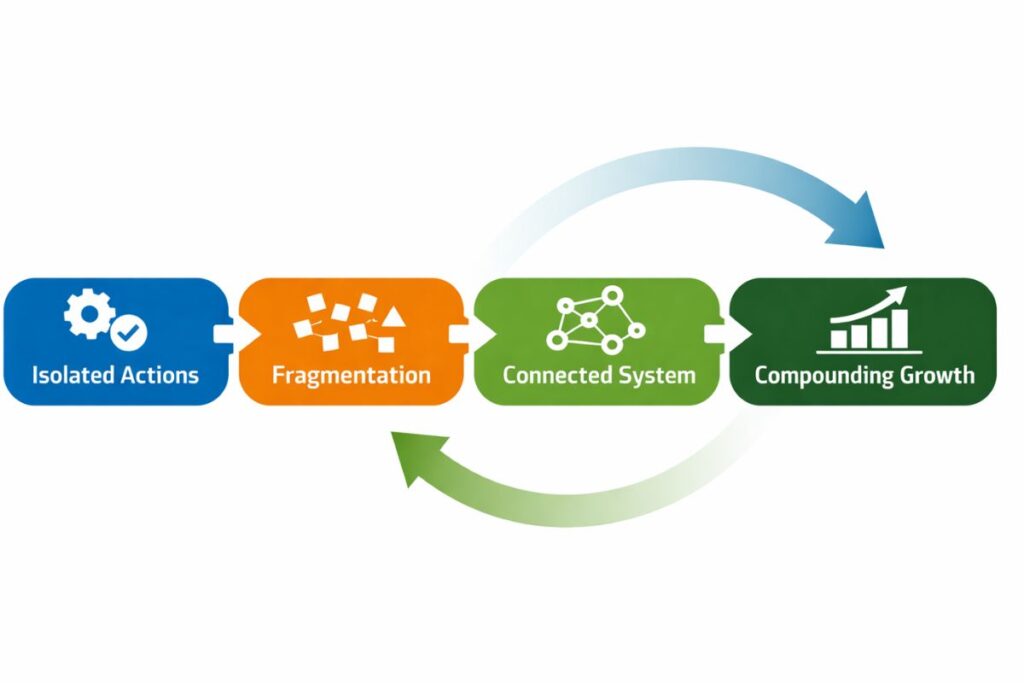
Table of Contents
Growth Doesn’t Collapse — It Gradually Stops Compounding
This is where the shift becomes harder to detect. Nothing breaks overnight. Campaigns still run, traffic still arrives and content continues to be published.
At the same time, something begins to feel off. Results fluctuate more than expected, scaling requires disproportionately more investment and what once worked starts to lose efficiency.
This is not a performance issue in isolation. It is structural fatigue: a system that can no longer support the level of complexity it has accumulated.
That is why understanding what a digital ecosystem in business actually is becomes critical. Without that perspective, businesses keep optimizing isolated parts of a system that was never designed to scale as a connected whole.
Growth does not usually collapse in one visible moment. It stops compounding. Each action may still produce a result, but those results no longer reinforce one another. The business keeps moving, but the system stops gaining leverage.
The Shift Most Businesses Avoid — From Actions to Systems
At first glance, the solution to inconsistent growth appears straightforward. If performance declines, the natural response is to improve execution: refine campaigns, optimize SEO, produce better content and expand acquisition channels.
This logic has guided digital strategy for years, and under certain conditions it still delivers incremental results. The problem is that incremental improvement is not the same as scalable growth.
As systems grow in complexity, execution alone begins to lose force. What once worked as a reliable path to scale gradually turns into a pattern of diminishing returns. Each improvement generates localized gains, but the overall system does not evolve at the same pace.
As a result, businesses work harder to maintain performance while true scalability remains out of reach.
The reason is structural.
Growth at this level is no longer determined only by the quality of individual actions. It is determined by how those actions connect within a broader system. When channels, data, content, SEO, CRM and customer experience operate in isolation, their impact cannot extend beyond their immediate function.
Performance becomes fragmented, and results fail to reinforce each other.
This is where the distinction between execution and system design becomes critical. Businesses that continue to operate through isolated optimization remain constrained by linear growth. In contrast, those that understand how digital ecosystems scale authority begin to approach growth as a function of structure rather than output.
The shift is subtle, but its implications are significant. Growth stops being a sequence of actions that generate results and becomes a property of the system itself, emerging from how data, content, authority, automation and experience are continuously connected and reinforced over time.
In practice, the Ecosystem Growth Engine becomes the mechanism that transforms structure into compounding growth.
This is also the point where traditional approaches start to lose relevance. As explored in digital ecosystems vs traditional SEO, optimizing isolated channels is no longer sufficient to sustain long-term visibility or competitive advantage.
What changes is not the importance of execution, but its role. Execution no longer drives growth on its own. It becomes one component within a larger system: one that either amplifies results through alignment or limits them through fragmentation.
Infrastructure Is Not About Tools — It Is About How the System Works
This is where the misunderstanding moves from tactical to structural.
Many businesses still interpret infrastructure as a technical layer: something defined by tools, platforms, integrations or software choices. In this view, improving infrastructure means adopting better technology, connecting more systems or increasing operational efficiency.
Those actions can improve execution, but they do not automatically change how the system behaves.
Tools enable activity. They allow campaigns to launch, processes to run, data to be collected and communication to happen at scale. But tools do not determine whether these elements connect, interact or reinforce each other over time.
Infrastructure operates at a different level.
It defines how data flows across the business, how decisions are informed, how content is structured, how SEO supports visibility, how CRM preserves customer context and how authority is built through consistent, aligned signals.
This is why understanding what digital infrastructure means in modern business is essential. It reframes infrastructure not as a technical stack, but as the underlying system that determines whether growth compounds or fragments.
The strategic question is not whether a company has tools. Most businesses do. The real question is whether those tools operate inside a coherent structure capable of supporting scalable growth.
The Hidden Cost of Fragmented Infrastructure
When infrastructure lacks coherence, the consequences are rarely immediate. They are cumulative, quiet and increasingly difficult to reverse.
At first, the system continues to function. Data is still collected, campaigns still run, forms still capture leads and reports still appear stable enough to guide decisions. But subtle inconsistencies begin to emerge.
Data becomes less reliable. Processes lose efficiency. Teams interpret different signals. Decision-making slows because the business has more information, but less clarity.
In response, teams try to compensate. More campaigns are launched, additional tools are adopted and manual interventions are introduced to maintain performance.
This creates a dangerous illusion of progress.
Activity increases, but leverage does not.
What appears to be growth is often a system working harder to produce the same, or diminishing, results. The business becomes more digitally active without becoming more structurally capable.
This dynamic is one of the core patterns explored in why businesses fail to build digital ecosystems, where fragmentation limits scalability long before the problem becomes visible.
Over time, the system does not collapse. It loses its ability to compound.
Why Authority Doesn’t Scale — Even When Content Does
This is one of the most misunderstood consequences of weak infrastructure.
Many businesses invest heavily in content and SEO expecting authority to grow proportionally. They publish more articles, optimize more pages and expand topical coverage, assuming that increased output will naturally create stronger relevance.
But authority does not behave like output.
Authority behaves like a system outcome.
When content exists without strong internal connections, when data signals are inconsistent, when pages are not organized into a clear knowledge structure and when customer experience does not support trust, every asset operates in isolation.
In that environment, publishing more does not necessarily build more authority. It can create more noise.
This is why understanding digital authority requires a structural perspective. Authority is not built only by publishing more. It emerges when content, infrastructure, trust signals, data and customer experience reinforce one another across the ecosystem.
As explored in how to scale digital authority through ecosystems, compounding visibility depends on alignment, not volume.
When infrastructure is weak, authority remains trapped inside isolated assets. When infrastructure is strong, every asset can strengthen the larger system.
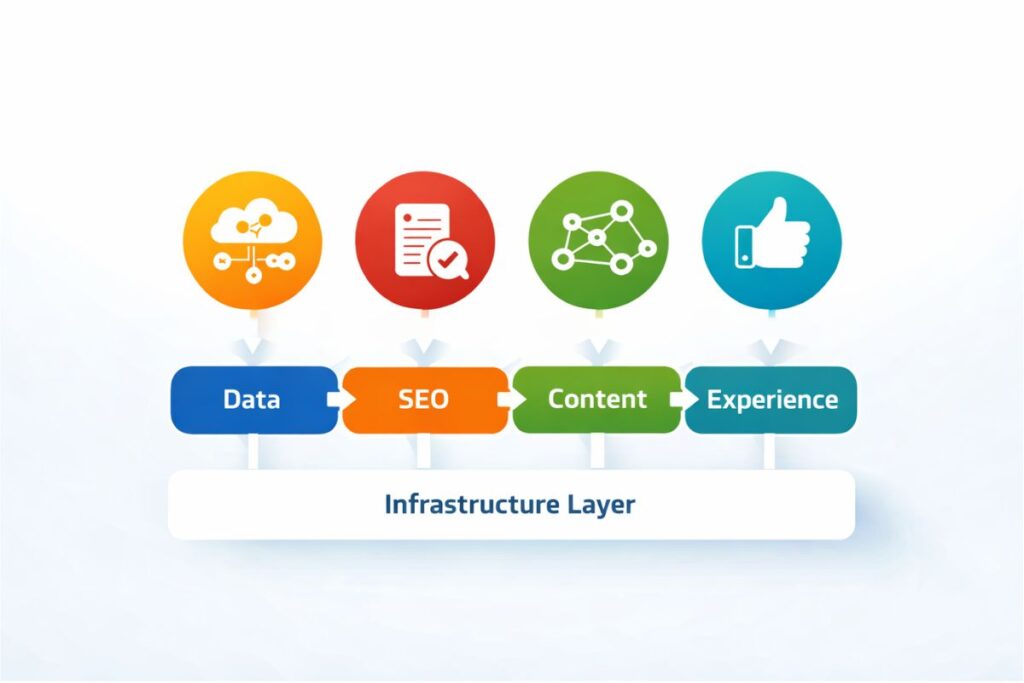
Data, SEO, and Structure — The System Behind Visibility
At this stage, it becomes clear that visibility is not simply a function of isolated optimization. It is the result of how multiple layers interact within a system.
For years, SEO, data and content were often treated as separate disciplines, each with its own tools, metrics and strategies. That separation made sense in simpler digital environments, where individual improvements could still produce measurable gains.
But as ecosystems grow in complexity, that distinction begins to break down.
What appears to be independent layers are, in reality, deeply connected components of the same system. Data informs decisions. SEO shapes how the business is discovered and interpreted. Content acts as the interface through which expertise, value and authority are delivered.
When these elements are aligned, they reinforce each other. When they are disconnected, they compete, fragment and dilute impact.
This is why SEO in digital ecosystems must be understood as a structural function, not only as a channel for acquisition.
It is also why the role of data in digital ecosystems extends far beyond analytics dashboards or reporting layers.
Data defines how the system perceives reality. It determines which signals are captured, how they are interpreted and how decisions are made across the entire structure.
SEO defines how that system is interpreted externally: how search engines understand relevance, relationships, entities and authority.
Structure determines whether these interactions create isolated outputs or compounding effects.
When structure is weak, insights do not propagate, authority does not accumulate and visibility remains inconsistent. When structure is aligned, every action strengthens the system as a whole.
The Digital Ecosystem Infrastructure Model™ — How Scalable Systems Are Designed
At this stage, the shift moves from conceptual understanding to operational clarity.
The limitation has already been identified: growth does not fail because execution disappears. It fails because the system is not designed to reinforce itself over time. Actions generate results, but those results remain isolated when there is no structure connecting them.
Recognizing this limitation is only the first step.
This is where most explanations stop. The problem is understood, the diagnosis is clear, but the transition from awareness to architecture is never fully completed.
That transition is where real scalability begins.
Not with more execution, but with the deliberate design of systems that connect, align and continuously reinforce every layer of digital activity.
Most Businesses Don’t Lack Tools — They Lack Structure
At first glance, most companies appear well-equipped to grow. They operate with advanced tools, multiple platforms, integrated data sources and technologies that promise efficiency, automation and scalability.
From the outside, the system may seem complete, even sophisticated.
But what exists in most cases is not a system. It is an accumulation.
Tools are added reactively to solve immediate challenges. Processes evolve independently across teams. Integrations are implemented to connect specific points, rather than to support a coherent architecture. Content is produced, data is collected and campaigns are launched, but the structure behind those actions remains unclear.
Over time, complexity grows faster than coordination.
The system expands, but it does not organize itself.
As a result, what appears to be digital growth is often only an increase in activity without a corresponding increase in leverage.
This is why the limitation is not usually a lack of resources, technology or capability. It is a matter of structure.
Complexity Is Not the Problem — Lack of Architecture Is
Digital ecosystems are inherently complex. Multiple channels, platforms, data sources, content layers, customer interactions and business processes are not optional. They are the environment in which modern businesses operate.
The challenge, therefore, is not to eliminate complexity. The challenge is to structure it.
Without a clear architecture, each additional layer introduces friction instead of leverage. Data becomes harder to trust, processes lose consistency and decision-making slows as signals become less reliable.
At the same time, different parts of the system begin to operate under conflicting logics. Marketing may optimize for traffic. Sales may prioritize lead quality. Content may focus on volume. Automation may run without enough customer context. Each function may be doing its job, but the system as a whole fails to compound.
This is where scalability breaks.
Not because the business lacks capability, but because the system lacks coherence.
Without coherence, growth cannot compound. It can only fluctuate.
In simple terms, scalable growth only happens when every layer of the system reinforces the next, creating a continuous loop of compounding results.
The Model That Turns Complexity Into Growth
The Digital Ecosystem Infrastructure Model™ organizes digital systems into interconnected layers that continuously reinforce each other.
Instead of allowing data, content, SEO, automation, authority and customer experience to operate in silos, the model connects them inside a unified structure where each layer strengthens the next.
This is what transforms digital growth from isolated performance into compounding outcomes.
Data → Integration → Automation → Authority → Experience
This is not a linear checklist. It is a system of reinforcement.
Data gives the business visibility into behavior, demand and friction. Integration allows that data to move across tools and teams. Automation turns connected information into continuity. Authority grows when content, SEO, trust signals and infrastructure reinforce the same strategic position. Experience becomes the visible result of everything operating together.
When these layers are disconnected, every improvement remains local. When they are aligned, every improvement strengthens the system as a whole.
That is the operational role of digital business infrastructure: to transform complexity into a structure capable of supporting scalable digital ecosystems.
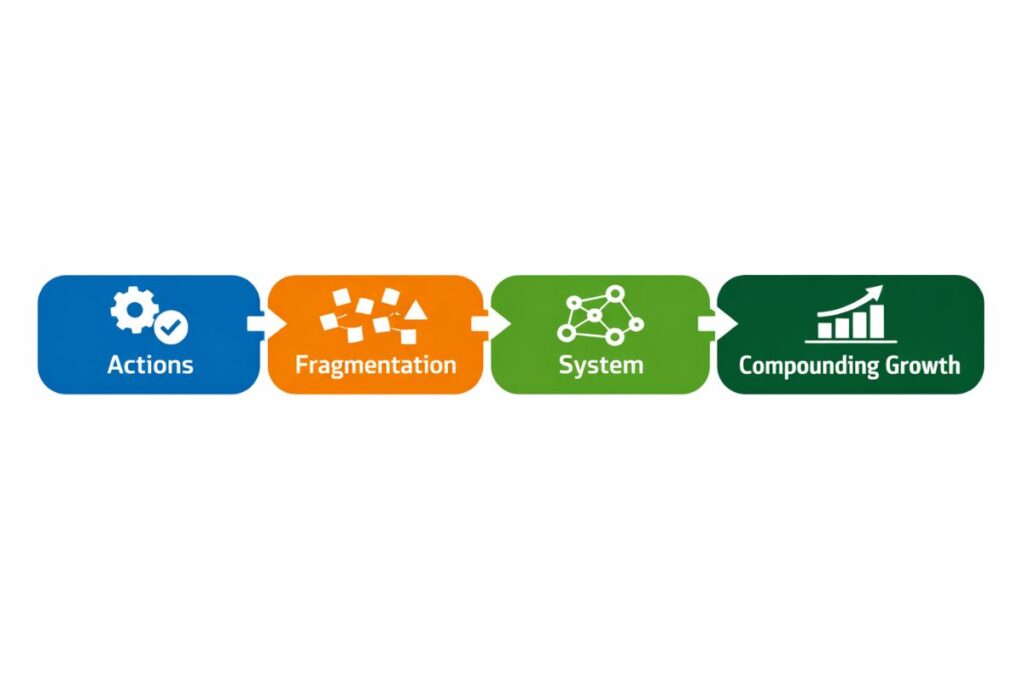
This is not a sequence of isolated steps.
It is a system of reinforcement, where each layer strengthens the next. Data gives the system clarity. Integration allows that clarity to move. Automation creates continuity. Authority compounds when signals align. Experience becomes the visible result of the entire structure working together.
Each layer builds on the previous one, and together they create a system capable of sustained, scalable growth.
Layer 1 — Data: The Foundation That Defines Everything Above It
Every digital system depends on data, but most businesses treat data as a byproduct instead of a foundation.
This is why understanding the role of data in digital ecosystems is critical. Data defines how the system perceives reality. It shows where demand comes from, how users behave, which content supports decisions and where friction appears across the customer journey.
When data is structured, decisions become clearer. When it is fragmented, every layer above it becomes less reliable. SEO decisions become weaker, content priorities become unclear, CRM records lose context and automation begins to operate on incomplete signals.
In a scalable infrastructure model, data is not only used for reporting. It becomes the foundation for learning.
Layer 2 — Integration: The Layer That Determines Whether the System Exists
Without integration, there is no system. There are only disconnected parts.
Data may exist, but it does not flow. Tools may function, but they do not align. Processes may run, but they do not coordinate. Teams may execute, but they do not operate from the same context.
This creates a silent failure: everything appears to work, but nothing compounds.
Integration is the layer that allows a business to connect website behavior, search visibility, CRM records, automation flows, content performance and customer interactions into one operating structure. It turns scattered signals into usable intelligence.
When integration is weak, every department sees only part of the journey. When integration is strong, the business begins to understand how visibility becomes interest, how interest becomes trust and how trust becomes growth.
Layer 3 — Automation: Where the System Starts to Move on Its Own
Once systems are connected, the next step is coordination.
Automation is not just about efficiency. It is about continuity.
It connects actions across layers, triggers processes and allows the system to operate beyond manual effort. A user interaction can inform a CRM stage. A CRM stage can trigger a relevant follow-up. A customer question can influence future content. A repeated behavior pattern can guide segmentation.
This is where growth begins to decouple from constant execution.
However, automation only strengthens infrastructure when it is built on reliable data and clear strategy. If the system is fragmented, automation can multiply inconsistency. If the system is aligned, automation helps the ecosystem maintain relevance at scale.
Layer 4 — Authority: The Layer Where Everything Compounds
This is where many digital strategies focus, but few fully understand the mechanism.
Authority is not a direct output of content or SEO alone. It is a structural effect.
When content, semantic structure, internal linking, data, trust signals and user experience are aligned, authority begins to compound naturally. Each asset reinforces the next. Each page clarifies the company’s expertise. Each internal link strengthens the relationship between ideas. Each consistent experience confirms credibility.
This is why understanding digital authority is essential inside the infrastructure model. Authority is not only what a business publishes. It is what the entire system repeatedly proves.
As explored in how digital ecosystems scale authority, visibility grows stronger when the system reinforces the same strategic position across content, SEO, data, infrastructure and customer experience.
Layer 5 — Experience: The Output That Reflects the Entire System
Experience is the layer users directly interact with, and it is often the layer businesses try to optimize first.
But experience is not created only at the interface.
It is produced by everything behind it: infrastructure, data quality, navigation, content structure, CRM context, automation logic, page performance, internal links and operational consistency.
When infrastructure is aligned, experiences feel seamless, relevant and consistent. Users can understand the business faster, move through content more naturally and trust the company with less friction.
When infrastructure is weak, friction appears regardless of design quality. Pages may look polished, but the journey feels disconnected. Content may be useful, but the next step is unclear. Automation may exist, but the message lacks context.
Experience is the visible proof of whether the system behind it is coherent.
Why Optimizing One Layer Will Never Fix the System
This is where many optimization efforts fail.
Businesses try to improve individual areas such as SEO, content, automation, analytics or conversion paths, expecting overall performance to improve. These improvements may produce local gains, but they cannot fix a system that is structurally misaligned.
When layers are disconnected, improvements do not propagate. A better article does not strengthen authority if it is isolated from the content architecture. A stronger automation flow does not improve trust if the CRM lacks customer context. More analytics do not improve decisions if data is not translated into action.
This is why growth often feels inconsistent. The business improves parts of the operation, but the system does not become stronger as a whole.
Scalability does not come from optimizing isolated layers. It comes from aligning the system so that each improvement reinforces the next.
Understanding the Model Is Only the Beginning
At this point, the structure is clear. The Digital Ecosystem Infrastructure Model™ explains how scalable digital ecosystems are designed and how infrastructure enables systems to reinforce their own growth.
But clarity at the conceptual level does not automatically translate into execution.
This is where a new challenge emerges, and where most businesses begin to struggle. If the model is clear, and its logic is increasingly evident, why do so many companies fail to implement it in practice?
The answer is not only technical.
It is structural, cultural and strategic.
Building digital infrastructure is not simply a matter of adopting tools or connecting platforms. It requires rethinking how the organization operates, how decisions are made, how content is structured, how data moves and how different layers of the business reinforce one another over time.
In other words, it demands a shift from isolated execution to system design.
That shift is significantly more difficult than it appears. Even with access to resources, data and technology, many companies remain unable to translate understanding into scalable outcomes because their operating model still rewards activity more than architecture.
The next challenge is not knowing that infrastructure matters. It is understanding what prevents businesses from building it consistently, and why complexity itself becomes one of the main barriers to growth.
Why Most Businesses Fail to Build Scalable Infrastructure — Even When They Know the Model
At this stage, the logic is no longer the issue. The model explains how scalable ecosystems are structured and why infrastructure determines long-term growth.
And yet, implementation consistently falls short.
This is where the real gap appears. The limitation is not knowledge, but the ability to operate within complexity without losing coherence.
As systems expand, new tools are added, processes evolve and data flows increase. However, without a unifying architecture, these elements do not integrate into a cohesive system. They accumulate.
And accumulation without structure leads to fragmentation.
This fragmentation is rarely visible at first. Individual components continue to function, results still occur and performance may even appear stable in the short term. But beneath the surface, the system begins to lose its ability to scale.
Signals become inconsistent, processes lose alignment and outcomes stop reinforcing each other.
This is one of the central dynamics explored in why businesses fail to build digital ecosystems. The system does not collapse immediately. It fragments.
And once fragmentation reaches a certain level, growth no longer compounds. It fluctuates.
The Stack Trap — When More Tools Create Less Clarity
When performance begins to decline or becomes inconsistent, the natural response is to increase capability. Businesses invest in new tools, adopt more advanced platforms and expand their technological stack in an attempt to regain control and improve results.
Individually, these decisions are logical. A more robust CRM promises better customer management. An advanced automation platform offers efficiency gains. Enhanced analytics tools provide deeper insights.
However, when these additions are made without a unifying structure, they do not strengthen the system. They fragment it.
This is the stack trap.
The system becomes more powerful in isolation, but less coherent as a whole. Data flows become inconsistent, integrations grow increasingly complex and different parts of the organization begin to operate under misaligned logic.
Over time, the very tools intended to improve performance start to reduce clarity, making it harder to understand what is actually driving results.
The issue, therefore, is not the presence of technology. It is the absence of architecture.
Why SEO Breaks When Infrastructure Is Weak
One of the most visible consequences of structural misalignment appears in SEO.
Businesses invest heavily in content, optimize pages and follow best practices, yet still struggle to build sustainable authority or maintain consistent visibility. At the surface, this often looks like a performance issue: something that could be solved with better keywords, stronger content quality or more aggressive optimization.
But in many cases, the limitation is structural.
The problem is rarely the quality of one individual asset. It is the lack of connection between assets.
When content is not semantically aligned, when internal linking does not reflect a coherent architecture and when data signals are inconsistent, search engines have a harder time interpreting the business as a unified authority environment.
This is why SEO in digital ecosystems must be understood as a system layer: one that depends on how content, data, structure, authority and user experience interact, rather than an isolated tactic focused only on individual pages.
Weak infrastructure does not only limit technical performance. It weakens the relationships that allow SEO value to compound across the ecosystem.
The Invisible Ceiling That Stops Growth
These dynamics converge into a pattern that is difficult to detect but highly consequential.
Growth does not collapse abruptly. Instead, the business gradually reaches a point where performance no longer scales in proportion to effort.
More resources are invested. More actions are executed. More content is published. More tools are adopted. Yet the incremental return continues to decline.
This is the structural ceiling.
At this stage, the system still functions. Campaigns still generate results, pages still attract visitors and tools still collect information. But the system has lost its ability to compound outcomes. Each action produces an output, but those outputs fail to reinforce one another over time.
Because this limitation emerges gradually, it is rarely recognized as an infrastructure problem. Instead, it is often misinterpreted as a need for more optimization, more execution or more tools.
That response reinforces the same cycle that created the constraint in the first place.
The invisible ceiling does not appear because the business stops working. It appears because the system cannot turn work into accumulated leverage.
The Future of Digital Ecosystems — And Why Infrastructure Becomes the Ultimate Advantage
At this point, the conversation shifts from diagnosing limitations to understanding where digital growth is heading.
The future is not being shaped only by new channels, isolated platforms or incremental improvements in execution. It is being shaped by how systems are designed, connected and continuously optimized as unified structures.
This shift is already visible in the evolution of the future of digital ecosystems, where growth depends less on the isolated performance of individual assets and more on how effectively the system reinforces its own outcomes.
In this context, infrastructure moves from a supporting layer to a central strategic advantage.
A business with strong infrastructure can adapt faster because its data, content, systems and customer interactions are already connected. A business with weak infrastructure may adopt the same tools, but those tools will operate inside a fragmented environment.
The difference will not be access to technology. It will be the ability to turn technology into coherent growth.
AI Will Not Fix the System — It Will Expose It
Artificial intelligence is accelerating execution across every layer of the digital environment. Content can be produced faster, data can be processed more efficiently and decision-making can become increasingly automated.
At first glance, this appears to solve many of the limitations businesses have faced.
But acceleration does not resolve structural problems. It amplifies them.
Systems that are already aligned can benefit from increased speed because data, content, automation and authority signals move through a coherent structure. In fragmented systems, AI often produces the opposite effect: more output, more inconsistency and more difficulty understanding what is actually driving results.
This is why the impact of AI on digital authority depends so heavily on infrastructure. AI can strengthen authority when the system has clarity. It can weaken authority when the system multiplies disconnected content, generic automation and unreliable signals.
The advantage is no longer defined by access to AI alone.
The advantage is defined by the infrastructure that allows AI to create coherent value.
The New Structure of Online Authority
As this shift unfolds, the concept of authority is also being redefined.
Authority is no longer built only through isolated pages, individual rankings or disconnected content strategies. It emerges from the coherence of the system: from how content, data, internal links, trust signals, infrastructure and customer experience align to create consistent evidence of relevance.
This is why digital ecosystems vs traditional SEO represents more than a comparison of methods. It reflects a structural transformation in how visibility is generated, interpreted and sustained over time.
Search visibility is becoming more dependent on relationships between entities, topics, pages, experiences and trust signals. In this environment, isolated optimization becomes less powerful than ecosystem-wide coherence.
The businesses that build authority through systems will be easier to understand, easier to trust and harder to replace.
The Strategic Shift Businesses Must Make Now
Given this context, the direction forward becomes clear, but not necessarily easy to execute.
Continuing to optimize isolated tactics may still produce short-term gains. Campaigns can be improved, content can be refined and performance can be temporarily increased. However, those gains do not automatically translate into sustainable growth inside increasingly complex digital environments.
The limitation is no longer tactical.
It is structural.
What is required is not another layer of optimization, but a shift in perspective: one that redefines how growth itself is approached.
This shift moves businesses away from managing disconnected channels and toward designing systems. It replaces execution as the only driver of results with infrastructure as the foundation of scalability.
In practical terms, it means transitioning from isolated actions that generate outcomes to connected ecosystems that continuously reinforce them.
This is not a minor adjustment. It is a structural repositioning.
Organizations that make this transition early gain more than operational efficiency. They gain the ability to scale with coherence, adapt without fragmentation and build authority that compounds over time.
More importantly, they begin to define the standards by which digital performance is measured.
In this new landscape, growth is no longer determined by how much a business does. It is determined by how well its system is designed to evolve.
The Final Shift — From Growth Tactics to Growth Systems
At this point, the underlying pattern becomes clear. What initially appears to be a challenge of execution is, in reality, a limitation of structure.
Digital growth does not scale through isolated actions. It scales through systems designed to reinforce themselves over time.
This is why digital business infrastructure cannot be reduced to a technical layer or a set of tools. It is the foundation that connects strategy, execution, data, content, CRM, automation and authority into a coherent system capable of compounding results.
When this structure is present, each action contributes to a larger dynamic. Data informs decisions. Content reinforces authority. SEO connects demand to structure. CRM preserves context. Automation creates continuity. Customer experience strengthens trust.
Growth, in this context, becomes a systemic outcome rather than a direct result of effort alone.
When this structure is absent, the opposite occurs. Actions generate results, but those results remain isolated. Performance fluctuates, complexity increases and scalability becomes increasingly difficult to sustain.
The implication is not subtle.
Businesses that continue to operate through fragmented strategies will face increasing difficulty as digital environments become more complex. In contrast, those that invest in structured systems will gain the ability to scale with coherence, adapt with consistency and build authority that compounds over time.
This is the shift that defines the next phase of digital growth.
Growth is no longer something a business simply executes.
It is something the system becomes capable of sustaining.
Frequently Asked Questions About Digital Business Infrastructure
What is digital business infrastructure?
Digital business infrastructure is the system that connects data, technology, processes, content, customer interactions and operational workflows into a unified structure that enables scalable growth.
Unlike a simple collection of tools, infrastructure defines how these elements interact over time. It shapes how a business operates, how decisions are made, how content supports authority and how customer journeys move across the digital ecosystem.
In this sense, digital business infrastructure is not only a technical layer. It is a strategic foundation that determines whether growth compounds or remains fragmented.
Why is infrastructure more important than tools?
Tools enable execution, but infrastructure determines whether that execution can scale.
Without a structured system, tools operate in isolation. Data becomes fragmented, processes lose alignment, content does not reinforce authority and results fail to compound over time.
Infrastructure ensures that every tool contributes to a larger system where actions are connected, insights are shared and outcomes strengthen the next stage of growth.
How does digital infrastructure impact SEO?
In modern digital ecosystems, SEO is no longer limited to page-level optimization. It depends on how content, data, internal links, semantic structure, user experience and authority signals are connected.
A well-structured infrastructure helps search engines interpret a business as a coherent authority environment, strengthening relevance, visibility and trust across the system.
This is why SEO in digital ecosystems increasingly functions as a structural layer, not just a channel for traffic acquisition.
What is the difference between a digital ecosystem and a traditional website?
A traditional website is usually a centralized asset focused on pages, rankings, information and conversion paths. A digital ecosystem is a broader connected structure where multiple assets, platforms, systems and content layers reinforce one another.
In ecosystems, authority and visibility are not concentrated only in one page or one channel. They emerge from how the entire system is structured and how its components support the same strategic position.
This is why understanding what a digital ecosystem in business means is essential for companies moving beyond isolated websites toward scalable digital growth.
Why do most businesses fail to scale their digital infrastructure?
Most businesses build infrastructure reactively. They add tools, create integrations and expand systems in response to immediate needs instead of following a unified architectural logic.
This leads to fragmentation, data silos, duplicated processes and operational inefficiencies that limit scalability over time.
The system grows in complexity, but not in coherence. This is one of the main reasons businesses fail to build digital ecosystems even when they have access to modern tools.
How does AI relate to digital infrastructure?
Artificial intelligence accelerates execution across digital systems, but it depends on infrastructure to create consistent value.
When systems are well structured, AI can improve efficiency, insight, personalization, content planning and decision-making. When systems are fragmented, AI can amplify inconsistency, duplicate output and make weak processes move faster without becoming clearer.
In this context, AI alone is not the advantage. Infrastructure determines whether AI strengthens the business or exposes the weaknesses already present in the system.
Can small businesses build digital business infrastructure?
Yes. Digital business infrastructure is not defined by company size. It is defined by how clearly the business organizes its tools, data, processes, content and customer interactions.
Small businesses can build scalable foundations by connecting their website, analytics, CRM, content structure, SEO strategy and customer communication from the beginning.
In many cases, starting with a clean structure is an advantage because it avoids the fragmentation that larger organizations often need to correct later.
Key References and Strategic Foundations
Digital business infrastructure does not exist in isolation. It connects ecosystems, data, authority, and execution into a unified system.
The resources below expand the core concepts behind this model and show how they apply in real-world scenarios.
Foundational Concepts
How Systems Scale
From Strategy to Execution
External Perspectives
Digital ecosystems scale when systems are connected — not when efforts are isolated.